
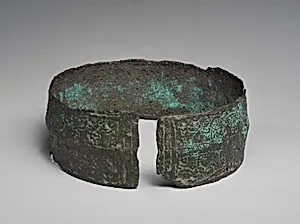
Bracelet
Unknown Artist
ca. 9th century BCE
Medium
Copper, bronze
Dimensions
1 in. × 2 1/2 in. × 2 1/2 in. (2.5 × 6.4 × 6.4 cm)
Classification
Metalwork-Ornaments
Culture & Period
Iran · Iron Age II, Hasanlu Period IV
Department
Ancient Near Eastern Art
Museum
Metropolitan Museum of Art, New York, NY
Credit
Purchase, Mrs. Constantine Sidamon-Eristoff Gift, 1961
Accession Number
61.100.24
Rights
Public Domain
Art Historical Context
This delicate bronze and copper bracelet, dating to around the 9th century, hails from ancient Iran during the Iron Age, specifically the Hasanlu IV. Unearthed from the archaeological site of Hasanlu—a key center of early Iron Age culture in northwestern Iran—this small ornament (just 1 inch high and 2½ inches wide) exemplifies the exquisite metalwork of the Ancient Near East. Adorned as personal jewelry, it would have been worn by elites, symbolizing status and craftsmanship in a time of emerging urban societies and fortified settlements. Crafted from copper and bronze, alloys that marked a technological leap in the Iron Age, the bracelet showcases advanced casting and hammering techniques. These methods allowed artisans to create lightweight yet durable pieces with intricate forms, blending functionality with aesthetic appeal. In Hasanlu's vibrant cultural milieu, such ornaments reflected trade networks spanning Mesopotamia and the Caucasus, highlighting Iran's role as a crossroads of innovation. Today, housed in the Metropolitan Museum of Art's Department of Ancient Near Eastern Art, this bracelet offers a tangible glimpse into daily life 3,000 years ago—where beauty and metallurgy intertwined to adorn the human form.