
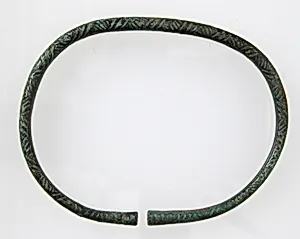
Bracelet
Unknown Artist
400–100
Medium
Copper alloy
Dimensions
Overall: 2 1/2 x 1 15/16 x 3/16 in. (6.3 x 4.9 x 0.5 cm)
Classification
Metalwork-Copper alloy
Culture
Celtic
Department
Medieval Art
Museum
Metropolitan Museum of Art, New York, NY
Credit
Gift of J. Pierpont Morgan, 1917
Accession Number
17.191.253
Rights
Public Domain
Art Historical Context
This delicate copper alloy bracelet, crafted by an unknown Celtic artist between 400 and 100 BCE, exemplifies masterful metalworking traditions of Iron Age Europe. Measuring just 2½ x 1⅞ x 3/16 inches, its compact form suggests it was worn as personal adornment, likely on the wrist or upper arm, reflecting the Celts' love for jewelry as symbols of status, identity, and craftsmanship. Copper alloys were prized for their workability, allowing artisans to hammer, cast, and possibly decorate pieces with subtle textures or motifs typical of Celtic designs. Hailing from the height of the La Tène period—the pinnacle of Celtic artistic expression—this bracelet highlights a culture that spanned much of continental Europe, from modern-day France to Britain, before Roman expansion. Celtic metalworkers were renowned for their technical skill and aesthetic flair, often imbuing everyday objects with ritual or protective significance. Though modest in scale, such items reveal a sophisticated society where jewelry bridged the practical and the spiritual. Now housed in the Metropolitan Museum of Art's Medieval Art Department, this piece entered the collection in 1917 as a gift from financier J. Pierpont Morgan. It invites us to ponder the lives of its ancient wearer, connecting museum-goers to the vibrant world of prehistoric Celts.