
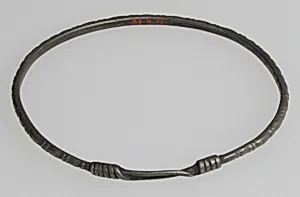
Bracelet
Unknown Artist
4th–7th century
Medium
Iron
Dimensions
Overall: 2 13/16 x 1/8 in. (7.1 x 0.3 cm)
Classification
Metalwork-Iron
Culture
Coptic
Department
Medieval Art
Museum
Metropolitan Museum of Art, New York, NY
Credit
Rogers Fund, 1931
Accession Number
31.8.11
Rights
Public Domain
Tags
Art Historical Context
This delicate iron bracelet, crafted by unknown Coptic artisan between the 4th 7th centuries, a glimpse into everyday life in early Christian Egypt. Measuring just 2 13/16 x 1/8 inches (7.1 x 0.3 cm), its slender form suggests it adorned the wrist of a common individual, evoking the blend of practicality and subtle elegance in Coptic personal adornment. Acquired through the Rogers Fund in 1931 and now housed in the Metropolitan Museum Art's Medieval Art Department it exemplifies metalwork from a culture at the crossroads of ancient Egyptian traditions and emerging Christianity. Iron, a robust yet humble medium compared to gold or silver, highlights the resourcefulness of Coptic craftsmen during Late Antiquity. Forged through hammering and possibly twisting techniques, such bracelets were durable for daily wear, symbolizing status or protection in a society influenced by Roman, Byzantine, and indigenous motifs. Coptic jewelry often carried spiritual undertones, reflecting the community's faith amid Egypt's transformation into a Christian stronghold before the Arab conquests. Though simple, this artifact underscores the artistry in the mundane—imagine it jingling softly on a Nile Valley dweller's arm, bridging us to a vibrant era of cultural fusion.