
Torc
Unknown Artist
4th–3rd century BCE
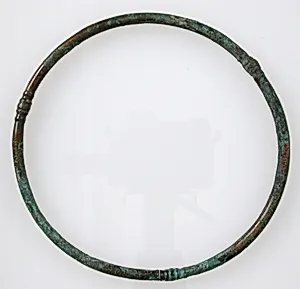
Medium
Copper alloy
Dimensions
Overall: 5 1/8 x 1/4 in. (13 x 0.7 cm)
Classification
Metalwork-Bronze
Culture
Celtic
Department
Medieval Art
Museum
Metropolitan Museum of Art, New York, NY
Credit
Gift of J. Pierpont Morgan, 1917
Accession Number
17.191.242
Rights
Public Domain
Art Historical Context
This exquisite copper alloy torc, dating to the 4th–3rd century BCE, hails from Celtic culture during the late Iron Age. Torcs like this were prestigious neck ornaments, often worn by warriors, chieftains, or elites as symbols of power, wealth, and social standing. Crafted from a durable copper alloy—closely akin to bronze—this rigid neck ring exemplifies the Celts' mastery of metalworking across ancient Europe, from Britain to the Continent. Its modest dimensions (5 1/8 x 1/4 in., or 13 x 0.7 cm) suggest it was designed for a slender neck or perhaps an arm, highlighting the versatility of Celtic jewelry. The torc's creation likely involved sophisticated techniques such as lost-wax casting or hammering, common in Celtic metalwork, allowing for intricate forms that balanced strength and elegance. Though the artist remains unknown, this piece reflects the La Tène-influenced aesthetic of swirling motifs and technical prowess that defined Celtic art. Donated to the Metropolitan Museum of Art in 1917 by J. Pierpont Morgan, it now resides in the Medieval Art department, bridging ancient craftsmanship with enduring cultural legacy. Step into the world of Celtic warriors through this timeless artifact— a tangible link to a vibrant, mysterious past!