
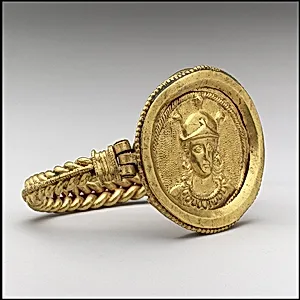
Bracelet with Bust of Roma
Unknown Artist
400–450
Medium
Gold
Dimensions
Overall: 1 5/8 x 2 3/16 x 2 11/16 x 1 3/4 in. (4.2 x 5.5 x 6.9 x 4.4 cm) Bezel: 1 5/8 x 1/4 in. (4.2 x 0.6 cm) braided wire: 5 11/16 x 3/16 x 5/16 in. (14.5 x 0.5 x 0.8 cm)
Classification
Metalwork-Gold
Culture
Byzantine
Department
Medieval Art
Museum
Metropolitan Museum of Art, New York, NY
Credit
Gift of J. Pierpont Morgan, 1917
Accession Number
17.190.2053
Rights
Public Domain
Art Historical Context
This exquisite gold bracelet, crafted around 400–450 CE during the early Byzantine era, features a bezel adorned with the bust of Roma, the ancient personification of Rome. Measuring just over 5 inches in circumference, its delicate construction— including intricately braided wire and a petite bezel—highlights the opulence of Late Antique jewelry. Produced in the Byzantine world, where the Eastern Roman Empire flourished, such pieces were luxury items reserved for the elite, symbolizing wealth, status, and continuity with Rome's imperial legacy. The bust of Roma, a nod to the city's enduring spirit amid the empire's transformations, underscores the cultural reverence for classical Roman iconography even as Christianity rose. Gold, prized for its luster and malleability, was hammered, twisted, and woven using advanced metalworking techniques like filigree and granulation, common in Byzantine craftsmanship. These methods not only ensured durability but also created shimmering surfaces that caught the light, evoking divine radiance. A generous gift from financier J. Pierpont Morgan to The Metropolitan Museum of Art in 1917, this bracelet offers a tangible glimpse into Byzantine daily splendor, bridging the worlds of pagan symbolism and emerging medieval artistry.