
Brahma
Unknown Artist
first quarter of the 10th century
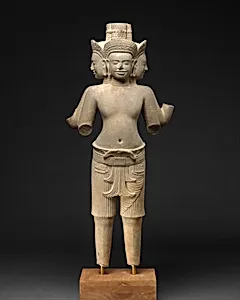
Medium
Sandstone
Dimensions
H. 47 1/2 in. (120.7 cm); W. 21 in. (53.3 cm); D. 9 in. (22.9 cm)
Classification
Sculpture
Culture & Period
Cambodia · Angkor period
Department
Asian Art
Museum
Metropolitan Museum of Art, New York, NY
Credit
Fletcher Fund, 1936
Accession Number
36.96.3
Rights
Public Domain
Tags
Art Historical Context
This sandstone sculpture of Brahma, created in the first quarter of the 10th century during Cambodia’s Angkor period, represents the Hindu creator god in a form typical of Khmer artistic traditions. Standing nearly four feet tall, the figure was likely part of a temple ensemble, where deities like Brahma, Vishnu, and Shiva played central roles in royal and religious life. Carved from durable local sandstone, the work reflects the technical skill of Angkorian artisans who produced monumental yet finely detailed sculptures for sacred spaces. In the Angkor era, Hinduism shaped much of Cambodia’s cultural and political landscape, with rulers commissioning temple complexes that embodied cosmic order. Brahma’s presence here underscores the integration of Indian religious concepts into Khmer society, where such images served both devotional and protective functions. The sculpture’s compact yet imposing dimensions suggest it may have occupied a niche or formed part of a larger architectural relief. Acquired by the Metropolitan Museum through the Fletcher Fund in 1936, this piece offers visitors a tangible connection to one of Southeast Asia’s most influential artistic traditions. Its survival highlights the enduring legacy of Angkorian craftsmanship and the spiritual worldview that inspired it.