
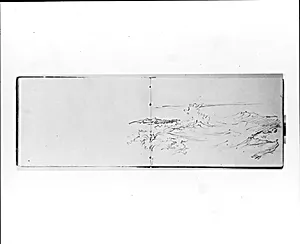
Breaking Waves (from Sketchbook VII)
Medium
Graphite on off-white wove paper
Dimensions
5 x 7 1/2 in. (12.7 x 19.1 cm)
Classification
Drawing
Culture
American
Department
The American Wing
Museum
Metropolitan Museum of Art, New York, NY
Credit
Purchase, Gifts in memory of Stephen D. Rubin, 1992
Accession Number
1992.2.1pp verso
Rights
Public Domain
Tags
About this artwork
This artwork titled "Breaking Waves (from Sketchbook VII)" by William Trost Richards dates to 1886. Executed in graphite on off-white wove paper, this work represents American artistic traditions. The piece demonstrates the technical skill and artistic vision characteristic of its period. The work's presence in a major museum collection attests to its significance in the broader narrative of art history. As part of institutional holdings, it serves both scholarly research and public education, o...
Art Historical Context
William Trost Richards, a American artist of the late 19th century, was renowned for his meticulous depictions of nature, particularly coastal scenes inspired by the rugged beauty of the Northeast. Created in 1886, *Breaking Waves (from Sketch VII)* is a delicate graphite drawing on off-white wove paper measuring just 5 x 7 1/2 inches. This sketch captures the dynamic energy of waves crashing ashore, showcasing Richards' keen observation of light, texture, and motion—hallmarks of his Pre-Raphaelite-inenced style and association with the Hudson River School tradition. Executed as part of a personal sketchbook series, the work highlights the artist's practice of on-site studies, blending technical precision with poetic reverence for the sea. Graphite's subtle tonal range allowed Richards to render foam, spray, and surging water with remarkable fluidity on the smooth wove paper, a favored support for quick yet detailed renderings during this era. Housed in The Metropolitan Museum of Art's American Wing, this piece underscores the cultural fascination with America's sublime landscapes amid rapid industrialization. It invites visitors to appreciate the quiet artistry behind grand paintings, offering a window into Richards' lifelong dedication to nature's fleeting moments.
About the Artist
William Trost Richards · 1833–1905
William Trost Richards (1833–1905) was a prominent American landscape and marine painter born in Philadelphia, where he attended Central High School before beginning his artistic training. Between 1850 and 1855, he studied part-time under the German-born Hudson River School artist Paul Weber while working as a designer and illustrator of ornamental metalwork. He exhibited his first works at the Pe...