
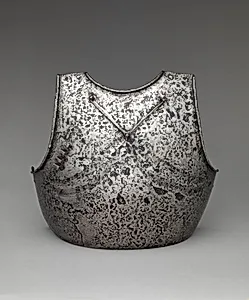
Breastplate with applied stop-rib
Unknown Artist
ca. 1420–40
Medium
Steel
Classification
Armor Parts-Breastplates
Culture
Italian
Department
Arms and Armor
Museum
Metropolitan Museum of Art, New York, NY
Credit
Bashford Dean Memorial Collection, Bequest of Bashford Dean, 1928
Accession Number
29.150.87
Rights
Public Domain
Art Historical Context
This elegant steel breastplate, crafted in Italy around 1420–40, exemplifies the pinnacle of early Renaissance armor design. During this transitional period from the Middle Ages, Italian armorer workshops in cities like Milan pioneered full plate armor, replacing heavier chainmail with fitted, lightweight steel plates for greater mobility on the battlefield. As a key torso protector, this breastplate have shielded a knight or man-at-arms from slashes, thrusts, and projectiles, reflecting the era's escalating demands of warfare amid Italy's fractious city-states. The standout feature is its "applied stop-rib"—a raised, welded steel ridge strategically positioned to deflect blows and arrows, showcasing sophisticated blacksmithing techniques. Hammered and polished to a subtle sheen, the steel's high-quality forging ensured both durability and ergonomic fit, often customized to the wearer's body. Such innovations highlight Italian armorers' blend of functionality and emerging aesthetic refinement, influencing European designs for centuries. Now part of the Metropolitan Museum of Art's renowned Arms and Armor collection, gifted through the Bashford Dean Memorial Collection in 1928, this piece invites us to ponder the armored warrior's world—where survival hinged on masterful metallurgy and ingenuity.