
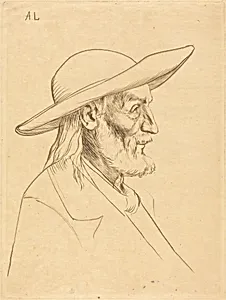
Breton Peasant (Paysan breton)
1826 to 1850
Medium
drypoint
Classification
Department
CG-E
Museum
National Gallery of Art, Washington, D.C.
Credit
Rosenwald Collection
Accession Number
1943.3.5388
Rights
Public Domain
Art Historical Context
Alphonse Legros, a French-born artist who later became a key figure in British art circles, captured the rugged dignity of rural life in *Breton Peasant (aysan breton)*, created between 1826 and 1850. This intimate print depicts a traditional figure from Brittany, France—a region celebrated for its Celtic heritage and resilient farming communities. Legros, influenced by the Realism movement, portrayed peasants not as romantic ideals but as authentic individuals, echoing contemporaries like Gustave Courbet and Jean-François Millet. The work's medium, drypoint, showcases Legros's mastery as a printmaker. In this intaglio technique, the artist scratches directly into a copper plate with a sharp needle, raising a soft burr that holds ink and produces richly textured, velvety lines. Unlike smoother etchings, drypoint allows for spontaneous, expressive strokes, lending the peasant's weathered features a tactile immediacy that draws viewers close. Housed in the National Gallery of Art's Rosenwald Collection (Department CG-E), this print highlights 19th-century fascination with folk culture amid France's industrialization. It invites us to appreciate the quiet strength of everyday heroes, bridging art and history with poignant simplicity.
About the Artist
Alphonse Legros · 1837–1911
Alphonse Legros (1837–1911) was born in Dijon, France, and trained in Paris at the drawing school of Horace Lecoq de Boisbaudran, whose unconventional teaching method — which emphasised memory drawing and acute observation over academic convention — would leave a lasting mark on Legros's practice. At Lecoq's school he formed friendships with Jules Dalou and Auguste Rodin that endured throughout hi...