
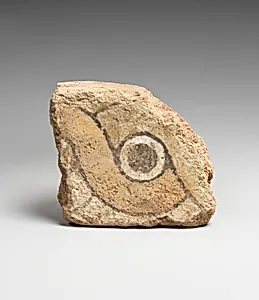
Brick
Unknown Artist
ca. 9th century BCE
Medium
Glazed ceramic
Dimensions
4 9/16 × 5 1/2 × 3 7/8 in. (11.6 × 14 × 9.8 cm)
Classification
Ceramics
Culture & Period
Assyrian · Neo-Assyrian
Department
Ancient Near Eastern Art
Museum
Metropolitan Museum of Art, New York, NY
Credit
Rogers Fund, 1957
Accession Number
57.27.25
Rights
Public Domain
Art Historical Context
This unassuming yet remarkable *Brick* hails from the Neo-Assyrian period, around the 9th century BCE, crafted by an unknown artist in the heart of ancient Mesopotamia. Measuring a compact 4 9/16 × 5 1/2 × 3 7/8 inches, this glazed ceramic piece exemplifies the engineering prowess of the Assyrian Empire one of the ancient Near East's most formidable powers. Assyrians were master builders, adorning their grand palaces and temples with such bricks to create vast, shimmering friezes that conveyed imperial might. The medium—glazed ceramic—represents a sophisticated technique for the era. Clay was molded, fired, and coated with a vitreous glaze, often in vibrant blues, yellows, or whites derived from minerals like copper and lead. This not only protected the bricks from the harsh environment but allowed for durable, colorful decorations on monumental scales, forming intricate patterns or reliefs of lions, gods, and kings that awed visitors to royal courts. In Assyrian culture, these bricks symbolized the empire's technological and artistic dominance, used in iconic structures like the palaces of Nimrud or Nineveh. Today, this artifact, acquired through the Rogers Fund in 1957, invites us at the Metropolitan Museum of Art to marvel at the ingenuity of a civilization that turned humble clay into eternal splendor.