
Bridal Long Pao (Dragon Robe)
1875/90, Qing dynasty (1644–1911)
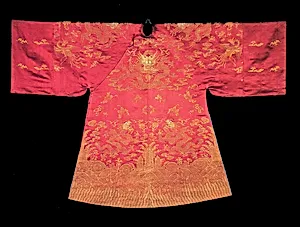
Medium
Silk and gold-leaf-over-lacquered-paper-strip-wrapped silk, warp-float faced 7:1 satin weave with supplementary brocading wefts bound in weft-float faced 1:2 'Z' twill interlacings; painted details; closures, ties, and lining: silk, 4:1 satin damask weave; metal clasps and knotted button
Dimensions
129.6 × 187.3 cm (51 × 73 3/4 in.)
Classification
textile
Department
Textiles
Museum
Art Institute of Chicago
Accession Number
47283
Rights
Public Domain
Art Historical Context
This exquisite *Bridal Long Pao or dragon robe, hails from the late Qing dynasty (1644–1911), a period when China's imperial court blended Manchu traditions with-Chinese craftsmanship. Dating to 1875–90 and made by Han-Chinese artisans it served as luxurious bridal attire for elite women, symbolizing prosperity, power, and auspicious unions. Dragon motifs, reserved for imperial circles under strict sumptuary laws, evoke the emperor's divine authority—here adapted for a bride, underscoring the robe's role in high-society weddings. Crafted from silk with gold-leaf-over-lacquered-paper-strip-wrapped silk threads, the robe employs a sophisticated warp-float faced 7:1 satin weave, enhanced by supplementary brocading wefts in 1:2 'Z' twill interlacings. Painted details, silk 4:1 satin damask linings, metal clasps, and knotted buttons add layers of opulence. Measuring 129.6 × 187.3 cm, its shimmering surface catches light like imperial splendor, showcasing Qing textile mastery that rivaled painting and porcelain in prestige. At the Art Institute of Chicago's Textiles Department, this robe invites us to marvel at China's weaving innovation, where every thread wove stories of status and celebration.
About the Artist
Han-Chinese
**Han-Chinese** was the collective attribution given to anonymous artisans of Han Chinese descent who crafted intricate embroidered textiles during the Qing dynasty (1644–1911). These makers, active primarily in the late 18th to early 20th centuries, specialized in luxurious garments and furnishings that showcased the pinnacle of Han Chinese needlework traditions. Their early lives and individual ...