
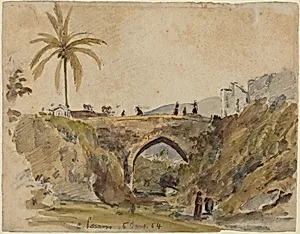
Bridge at Caracas
1854
Medium
transparent watercolor and graphite on wove paper
Dimensions
overall: 24 x 30.5 cm (9 7/16 x 12 in.)
Classification
Drawing
Department
CG-E
Museum
National Gallery of Art, Washington, D.C.
Credit
Collection of Mr. and Mrs. Paul Mellon
Accession Number
1985.64.108
Rights
Public Domain
Art Historical Context
Welcome to the National Gallery of, where we spotlight *Bridge at Caracas* (1854), an early gem by Camille Pissarro from the Collection of Mr. and Mrs. Paul Mellon. At just 24 years old Pissarro created this intimate drawing during his formative travels in Venezuela, a pivotal chapter before he became a cornerstone of Impressionism. Departing from his family's merchant life in the Caribbean, he embraced the lush tropics, capturing the vibrant landscapes of Caracas—a bustling colonial hub blending European architecture with natural splendor. Rendered in transparent watercolor and graphite on wove paper (24 x 30.5 cm), the work exemplifies 19th-century sketching techniques. The watercolor's luminous washes allow light to interplay with graphite's precise lines, evoking atmospheric depth in this riverside bridge scene. Such mixed media was ideal for plein air studies, highlighting Pissarro's budding sensitivity to nature's fleeting effects—foreshadowing his later revolutionary brushwork. This drawing offers a rare glimpse into Pissarro's pre-Paris evolution, bridging Romantic realism and the Impressionist innovations he would champion with Monet and Renoir. A testament to his wanderlust and raw talent, it invites us to trace the roots of modern landscape art.
About the Artist
Camille Pissarro · 1831–1903
Camille Pissarro (1830-1903) stands as the patriarch of Impressionism, the only artist to exhibit in all eight Impressionist exhibitions and a mentor whose influence shaped the trajectory of modern art. Born Jacob Abraham Camille Pissarro on the Caribbean island of St. Thomas to a Jewish-Portuguese merchant family, he abandoned the family business to pursue painting, eventually settling in Paris i...