
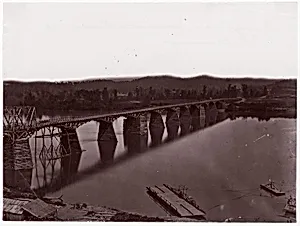
Bridge over Tennessee River at Chattanooga
Medium
Albumen silver print from glass negative
Classification
Photographs
Department
Photographs
Museum
Metropolitan Museum of Art, New York, NY
Credit
Harris Brisbane Dick Fund, 1933
Accession Number
33.65.408
Rights
Public Domain
Tags
Art Historical Context
**Bridge over Tennessee River at Chattanooga (ca. 1864) is a striking albumen silver print from glass negative, captured by photographers George N. Barnard and B. Brady. As pioneers of wartime photography, they documented the American Civil War through the relatively new medium of wet-collodion negatives, which produced richly detailed images on paper coated with egg-white albumen. This technique, popular in the 1860s, allowed for crisp contrasts and subtle tones, making it ideal for recording vast landscapes and engineering feats amid conflict. The photograph depicts a vital bridge spanning the Tennessee River at Chattanooga, a strategic hub during the Civil War. Chattanooga's position was crucial in late 1863 battles, where Union forces under General Ulysses S. Grant fought to secure supply lines against Confederate defenders. This image likely captures Union engineering efforts to maintain connectivity over the river, highlighting the war's reliance on infrastructure for troop movements and logistics. Housed in The Metropolitan Museum of Art's Photographs Department (Harris Brisbane Dick Fund, 1933), the print offers a window into the Civil War's industrial scale. Barnard's on-the-ground work in the Western Theater complements Brady's studio legacy, preserving not just battles but the everyday machinery of war for future generations. A testament to photography's emerging role as historical witness. (198 words)
About the Artist
George N. Barnard|Mathew B. Brady · 1819–present
George N. Barnard (1819–1902) was a pioneering American photographer whose six-decade career spanned the dawn of the medium, from daguerreotypes to Civil War documentation. Born into a farming family in Coventry, Connecticut, on December 23, 1819, he lost his father at age seven and apprenticed in family businesses before marrying in 1843 and relocating to Oswego, New York. There, he launched one ...