
Brief aan Ninon
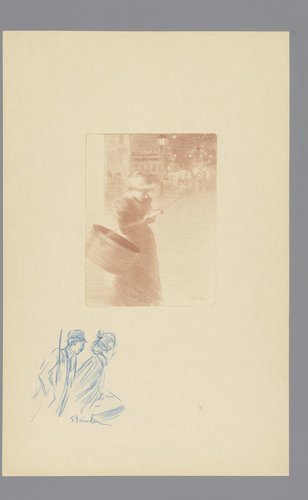
Medium
lithography
Dimensions
501; 323
Rights
Public Domain
About this artwork
lithografie in roodbruin op Japans papier
Art Historical Context
Théophile Alexandre Steinlen’s “Brief aan Ninon” (1897) is a striking example of late-nineteenth-century lithography. Swiss-French artist closely associated with the Art Nouveau movement and the bohemian circles of Montmartre, Steinlen frequently turned to printmaking to reach wide audiences with images drawn from everyday Parisian life. Here the medium is used with particular refinement: the design is printed in a warm reddish-brown ink on delicate Japanese paper, a support prized for its smooth surface and subtle texture that allows fine lines and tonal gradations to register beautifully. Measuring roughly 50 by 32 centimeters, the print’s intimate scale invites close viewing and suggests it may have been created as a limited-edition illustration or collector’s sheet rather than a large poster. Lithography’s ability to reproduce soft, painterly effects without the harshness of engraving made it ideal for Steinlen’s expressive style, while the choice of Japanese paper added an element of luxury and permanence. Today the work stands as both a technical and cultural artifact, illustrating how artists of the Belle Époque used accessible yet sophisticated print techniques to blend literature, narrative, and visual poetry.
About the Artist
Théophile Alexandre Steinlen · 1859–1923
Théophile Alexandre Steinlen, born on November 10, 1859, in Lausanne, Switzerland, hailed from a family with artistic roots; his grandfather, Christian Gottlieb Steinlen, was a painter and draftsman. After two years studying theology at the University of Lausanne, he trained in industrial ornamental drawing in Mulhouse under Schoenhaupt and worked as a designer trainee at a textile mill. Encourage...