
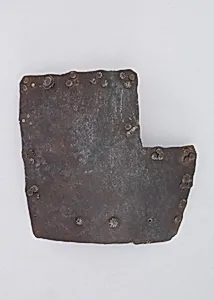
Brigandine Plate
Unknown Artist
1400–1450
Medium
Iron alloy
Dimensions
H. 6 1/4 in. (15.9 cm); W. 6 1/4 in. (15.9 cm); Wt. 9.8 oz. (277.8 g)
Classification
Armor Parts
Culture
Italian
Department
Arms and Armor
Museum
Metropolitan Museum of Art, New York, NY
Credit
Bashford Dean Memorial Collection, Bequest of Bashford Dean, 1928
Accession Number
29.150.90aa
Rights
Public Domain
Art Historical Context
This compact Brigandine Plate, crafted in Italy between 1400 and 1450, exemplifies the ingenuity of late medieval armorers during a time of evolving warfare in Renaissance Europe. Measuring just 6¼ inches square and weighing under 10 ounces, it formed part of a brigandine—a flexible defensive garment worn by infantry and light cavalry. Hundreds of such iron alloy plates were riveted inside a fabric or leather shell, offering protection against slashes and thrusts while allowing greater mobility than full plate armor. Brigandines rose in popularity amid the Hundred Years' War and Italian city-state conflicts, blending the durability of metal with the comfort of padded defenses. Italian workshops were renowned for their precise metallurgy, producing lightweight yet resilient alloys that balanced strength and wearability. This plate's modest scale highlights the modular design, enabling repairs by replacing individual pieces. Now housed in The Metropolitan Museum of Art's Arms and Armor Department, it entered the collection through the 1928 bequest of Bashford Dean, a pioneering arms scholar. For visitors, it offers a tangible glimpse into the daily perils faced by 15th-century soldiers, reminding us how craftsmanship turned raw iron into lifesaving art.