
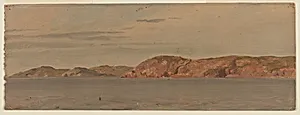
Brimstone Head, Fogo Island, Canada
June–July 1859
Classification
landscapes
Department
Smithsonian Collection
Museum
Smithsonian American Art Museum
Credit
Gift of Louis P. Church
Accession Number
1917-4-288-a
Rights
Public Domain
About this artwork
Research in Progress
Art Historical Context
Frederic Edwin Church, a leading figure of the Hudson River School, captured the dramatic ruggedness of Brimstone on Fogo Island, Canada, his sketching trip in June–July 1859. This reflects Church's passion for exploring North America's wild terrains, from the Catskills to Newfoundland's stark coastlines. Painted on-site, it showcases his meticulous observation of nature's sublime power—towering rock formations against vast skies and seas—evoking awe and the divine in everyday wilderness. As a quintessential Hudson River School work, *Brimstone Head* embodies luminism, with its emphasis on light effects, atmospheric depth, and harmonious compositions that celebrate America's untamed beauty. Church's expeditions, like this one, fueled the 19th-century romantic ideal of landscape as spiritual revelation, influencing generations of American artists. Though the medium remains unidentified amid ongoing research, its classification as a landscape underscores Church's legacy in elevating nature as a national treasure. Now in the Smithsonian American Art Museum as a gift from Louis P. Church, this piece invites visitors to ponder the artist's adventurous spirit and the timeless allure of coastal drama. (178 words)