
British Legation, Teheran
1858
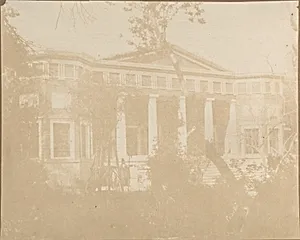
Medium
Salted paper print from paper negative
Classification
Photographs
Department
Photographs
Museum
Metropolitan Museum of Art, New York, NY
Credit
Gift of Kay Gregory, 1967
Accession Number
67.606.11
Rights
Public Domain
Tags
Art Historical Context
In 1858, Italian photographer Luigi Pesce captured British Legation in Teheran (modern-day Tehran, Iran) using the salted paper print process from a paper negative—a pioneering wet-collodion technique popular in the mid-19th century. early photographic medium, with its warm sepia tones and subtle gradations, allowed Pesce to document architecture with remarkable detail and atmospheric depth, preserving a moment in time when photography was still a novel art form bridging science and visual storytelling. The image depicts the grand facade of the British diplomatic compound during the Qajar era, a period of heightened geopolitical tensions in Persia known as the "Great Game" between Britain and Russia. Pesce, a naval officer turned photographer, traveled extensively in the region, creating one of the earliest photographic records of Iranian landmarks and foreign legations. Housed in the Metropolitan Museum of Art's Photographs Department (gift of Kay Gregory, 1967), this work highlights photography's role in ethnography and diplomacy, offering visitors a window into 19th-century cross-cultural exchanges and the built environment of colonial outposts. Its cultural significance lies in bridging East and West: the legation symbolized British influence amid Persia's modernization, while Pesce's lens provided an objective, non-painterly view of architecture previously known mainly through sketches or paintings. A testament to photography's documentary power.
About the Artist
Luigi Pesce · 1818–1891
**Luigi Pesce (1828–1864)** was an Italian colonel and pioneering amateur photographer from Naples in the Kingdom of the Two Sicilies, whose work captured some of the earliest images of Iran's ancient monuments and 19th-century life. Arriving in Persia in 1848 during the reign of Naser al-Din Shah Qajar, Pesce was tasked with training Iranian infantry units, a mission that positioned him ideally t...