
Brittany Landscape
1888
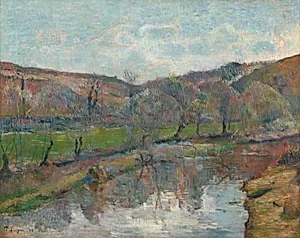
Medium
oil on canvas
Dimensions
overall: 71.1 x 89.5 cm (28 x 35 1/4 in.) framed: 91.4 x 115.6 cm (36 x 45 1/2 in.)
Classification
Painting
Department
CF
Museum
National Gallery of Art, Washington, D.C.
Credit
Chester Dale Collection
Accession Number
1963.10.148
Rights
Public Domain
Art Historical Context
Paul Gauguin painted *Brittany Landscape* in 1888 while working in the rural region of Pont-Aven, France. Seeking inspiration beyond the bustling art scene of Paris, the artist immersed himself in the quiet countryside, where the rugged terrain and local traditions profoundly shaped his evolving vision. This oil on canvas, measuring roughly 28 by 35 inches, captures the essence of that period of experimentation. Gauguin’s approach in this work reflects his growing interest in Synthetism, a style that emphasized bold color, simplified forms, and emotional resonance over strict realism. Using traditional oil paints allowed him to layer rich hues and create a sense of depth while flattening space, moving away from Impressionist techniques toward more symbolic expression. The painting stands as an early example of his departure from conventional European art, foreshadowing the vibrant, non-naturalistic works he would later create in Tahiti. Today housed in the National Gallery of Art’s Chester Dale Collection, *Brittany Landscape* offers visitors a window into Gauguin’s transformative journey. Its modest scale invites close viewing, revealing the artist’s deliberate brushwork and harmonious palette that continue to captivate audiences more than a century later.
About the Artist
Paul Gauguin · 1848–1903
Paul Gauguin (1848-1903) was a French Post-Impressionist painter whose bold experiments with color, form, and subject matter made him one of the most influential figures in the transition from 19th-century art to modernism. His rejection of European civilization for the perceived authenticity of 'primitive' cultures established an archetype of artistic exile that continues to resonate. Gauguin's ...