
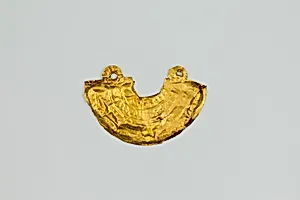
Broad collar amulet
Unknown Artist
664–380 B.C.
Medium
Gold sheet
Dimensions
l. 2.9 cm (1 1/8 in.) × h. 1.9 cm (3/4 in.)
Classification
Amulet, broad collar
Period
Late Period
Department
Egyptian Art
Museum
Metropolitan Museum of Art, New York, NY
Credit
Gift of Mr. and Mrs. V. Everit Macy, 1923
Accession Number
23.10.68
Rights
Public Domain
Art Historical Context
This delicate **Broad Collar Amulet**, crafted from a thin gold sheet during Egypt's Late Period (664380 B.C.), specifically Dynasties 26–29, exemplifies exquisite jewelry of ancient Egyptian elites. Measuring just 2.9 cm long by 1.9 cm high, this petite pendant was likely part of a broader necklace or worn as a protective talisman. Gold, a divine metal symbolizing the sun god Ra's eternal flesh, was reserved for high-status objects, underscoring the wearer's wealth and piety. In the Late Period, often called the Saite Renaissance, artisans revived Old Kingdom styles amid political revival and foreign influences. Broad collar amulets, mimicking the wide beaded necklaces favored by pharaohs and nobility, served apotropaic purposes—warding off evil and ensuring safe passage to the afterlife. The use of hammered gold sheet suggests skilled repoussé techniques, where the metal was shaped with punches for intricate designs, though this small scale highlights masterful precision. A generous gift to the Metropolitan Museum of Art in 1923 from Mr. and Mrs. V. Everit Macy, this amulet invites us to marvel at Egypt's enduring love for personal adornment that bridged the earthly and divine. Though tiny, it carries the grandeur of a bygone era.