
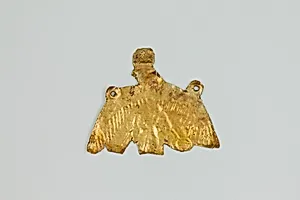
Falcon amulet
Unknown Artist
664–380 B.C.
Medium
Gold sheet
Dimensions
l. 3.2 cm (1 1/4 in.) × h. 2.5 cm (1 in.)
Classification
Amulet, falcon
Period
Late Period
Department
Egyptian Art
Museum
Metropolitan Museum of Art, New York, NY
Credit
Gift of Mr. and Mrs. V. Everit Macy, 1923
Accession Number
23.10.45
Rights
Public Domain
Tags
Art Historical Context
This exquisite falcon amulet, crafted from a delicate gold sheet during Egypt's Late Period (Dyn 26–29, ca. 664–380 B.C.), measures just 3.2 cm long and 2.5 cm high—small enough to wear as jewelry or suspend from a necklace. Produced by an unknown artisan, its shimmering gold medium was prized in ancient Egypt for its divine associations with eternity and the sun god Ra, often hammered into intricate shapes using repoussé techniques to evoke lifelike feathers and a poised stance. In Egyptian culture, the falcon embodied Horus, the sky god of kingship, protection, and vengeance, making such amulets powerful talismans. Worn by the living or placed in tombs, they warded off evil and ensured safe passage in the afterlife, reflecting the Late Period's blend of traditional piety and refined artistry amid political turmoil under native and foreign rulers. A generous gift to the Metropolitan Museum of Art from Mr. and Mrs. V. Everit Macy in 1923, this tiny treasure invites us to marvel at how ancient Egyptians packed profound spiritual meaning into everyday objects, bridging the mortal world and the divine.