
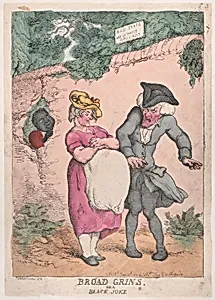
Broad Grins, or a Black Joke
June 4, 1812
Medium
Hand-colored etching
Dimensions
Sheet: 13 9/16 × 9 1/2 in. (34.4 × 24.1 cm)
Classification
Prints
Department
Drawings and Prints
Museum
Metropolitan Museum of Art, New York, NY
Credit
The Elisha Whittelsey Collection, The Elisha Whittelsey Fund, 1959
Accession Number
59.533.1960
Rights
Public Domain
Tags
Art Historical Context
Step into the witty world of Regency-era satire *Broad Grins, or Black Joke*, a hand-colored etching created by renowned caricaturist Thomas Rowlandson published by Thomas Tegg June 4, 1812—likely coinciding with King George III's birthday celebrations. 13 9/16 × 9 1/2 inches, this print exemplifies the booming British caricature market, where affordable, vividly colored etchings poked fun at society, politics, and human folly. Rowlandson, a master of exaggerated, humorous vignettes, belonged to the golden age of satirical printmaking in early 19th-century London. Hand-coloring, applied by skilled artisans after printing, brought lively tints to the etched lines, enhancing its appeal for middle-class buyers at shops like Tegg's. The title hints at broad, exaggerated smiles and a cheeky "black joke," tagging themes of men and women in playful or mocking scenarios—a staple of the era's social commentary. Housed in the Metropolitan Museum of Art's Elisha Whittelsey Collection, this work captures the cultural zest of Georgian Britain, where satire served as both entertainment and critique. It's a window into how prints democratized art, sparking laughs and debates among diverse audiences.