
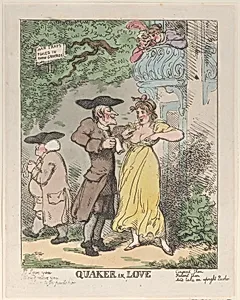
Quaker in Love
1815 (?)
Medium
Hand-colored etching
Dimensions
Sheet (inset): 9 15/16 × 7 13/16 in. (25.3 × 19.8 cm)
Classification
Prints
Department
Drawings and Prints
Museum
Metropolitan Museum of Art, New York, NY
Credit
The Elisha Whittelsey Collection, The Elisha Whittelsey Fund, 1959
Accession Number
59.533.1605
Rights
Public Domain
Tags
Art Historical Context
**Quaker in Love**, a hand-colored etching from around 1815, captures the satirical flair of Thomas Rowlandson, master British caricaturist, in collaboration with Charles Dibdin Rowlandson, renowned for his, exaggerated depictions of Regency-era society, often poked fun at human foibles through witty prints. This work, measuring about 10 by 8 inches, exemplifies the popular hand-colored etching technique, where vibrant hues added by hand enhanced the etching's appeal, making it a sought-after collector's item in early 19th-century England. The scene humorously portrays a Quaker—known for their plain dress, sobriety, and moral rigor—succumbing to romantic passion, blending men and women in a comedic entanglement. This satire likely lampoons the contrast between Quaker austerity and earthly desires, a common target in Georgian caricatures that critiqued social and religious hypocrisies during a time of rapid social change post-Napoleonic Wars. Housed in the Metropolitan Museum of Art's Drawings and Prints department as part of The Elisha Whittelsey Collection, this print highlights the cultural role of satirical etchings in shaping public discourse. Rowlandson's dynamic lines and Dibdin's probable textual contribution underscore the era's fusion of visual art and popular song, offering visitors a window into Britain's irreverent humor.
About the Artist
Thomas Rowlandson|Charles Dibdin · 1756–1827
Thomas Rowlandson (1757–1827) was an English artist and caricaturist whose satirical watercolors and prints captured the social life of Georgian Britain with unparalleled wit and technical mastery. Alongside James Gillray, he is recognized as one of the greatest British graphic artists, and his distinctive flowing line and keen observations have made his work integral to understanding late 18th an...