
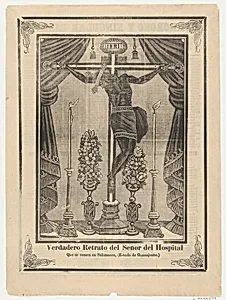
Broadsheet relating to Our Lord of the Hospital (Salamanca, Guanajuato) on a crucifix on an altar
Medium
Photorelief and letterpress
Dimensions
Sheet: 16 1/8 × 11 13/16 in. (41 × 30 cm)
Classification
Prints
Department
Drawings and Prints
Museum
Metropolitan Museum of Art, New York, NY
Credit
The Elisha Whittelsey Collection, The Elisha Whittelsey Fund, 1946
Accession Number
46.46.279
Rights
Public Domain
Tags
Art Historical Context
This striking 1903 broadsheet, printed by the renowned Mexican publisher Antonio Vanegas Arroyo, honors *Our Lord of the Hospital from Salamanca, Guanaju—a revered Christ figure depicted on a crucifix atop an altar. Produced anonymously in design but bearing Arroyo's imprint, the sheet measures 16⅛ × 11⅞ inches and exemplifies early 20th-century Mexican art. Housed in the Metropolitan Museum of Art's Drawings and Prints department, it captures the intense piety surrounding local miracle-working images, blending sacred iconography with accessible print culture. Arroyo's workshop revolutionized popular Mexican printmaking through techniques like photorelief—a halftone process for reproducing photographs—and letterpress for bold text. This combination allowed vivid, detailed imagery of the Crucifixion to reach everyday devotees, fostering widespread religious devotion. Broadsheets like this served as affordable votive aids, news of miracles, and tools for community faith, reflecting Mexico's vibrant fusion of Catholic tradition and emerging mass media post-Independence. Its cultural significance lies in preserving regional lore: *Our Lord of the Hospital* likely embodied healing and protection for Guanajuato's faithful. A testament to print's democratizing power, this piece invites us to ponder how art bridged the divine and the daily in early modern Mexico.
About the Artist
Anonymous|Antonio Vanegas Arroyo
In the vast tapestry of art history, "Anonymous" stands not as a singular individual but as a collective designation for countless unidentified creators whose works have endured across millennia. These artists, spanning prehistoric cave painters to medieval illuminators and folk craftsmen, produced the foundational layers of human visual culture. Prior to the Renaissance, when individual fame emer...