
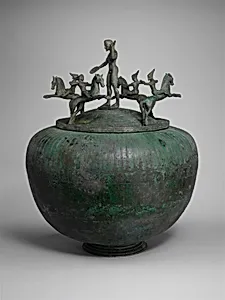
Bronze cinerary urn with lid
Unknown Artist
ca. 500 BCE
Medium
Bronze
Dimensions
19 1/16 in. × 16 in. (48.5 cm)
Classification
Bronzes
Culture & Period
Etruscan, Campanian · Archaic
Department
Greek and Roman Art
Museum
Metropolitan Museum of Art, New York, NY
Credit
Purchase, Joseph Pulitzer Bequest, 1940
Accession Number
40.11.3a, b
Rights
Public Domain
Tags
Art Historical Context
This exquisite bronze cinerary urn with lid, dating to around 500 BCE, hails from the Etruscan culture in the Campanian region ancient Italy during the Archaic period.ed as a vessel for cremated ashes, it exemplifies the Etruscans' sophisticated funerary practices, where such urns served not only practical purposes but also as symbols of status and the journey to the afterlife. Standing at 19 1/16 inches tall, its robust form reflects the era's emphasis on durable, monumental objects. The urn's decoration likely features dynamic motifs of horses and male nudes, hallmarks of Etruscan art influenced by Greek models yet distinctly Italic in vigor. Horses evoked speed and vitality in the underworld, while nude male figures celebrated heroic ideals and physical prowess. Cast in bronze—a medium in which Etruscans excelled through advanced lost-wax techniques—this piece showcases their mastery of metallurgy, producing intricate details that have endured for millennia. Acquired by the Metropolitan Museum of Art in 1940 through the Joseph Pulitzer Bequest, this urn offers a window into pre-Roman Italy's vibrant world, bridging Archaic experimentation and the grandeur that would inspire later classical art. A testament to Etruscan innovation, it invites us to ponder the lives and beliefs of a civilization that shaped Western heritage.