
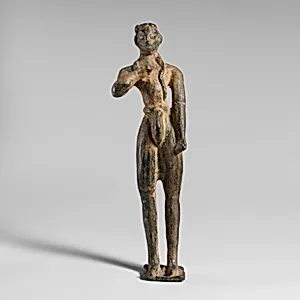
Bronze statuette of a votary
Unknown Artist
ca. 1600 BCE or later
Medium
Bronze
Dimensions
H. 7 13/16 in. (19.8 cm)
Classification
Bronzes
Culture & Period
Minoan · Late Bronze Age or Modern
Department
Greek and Roman Art
Museum
Metropolitan Museum of Art, New York, NY
Credit
Bequest of Walter C. Baker, 1971
Accession Number
1972.118.45
Rights
Public Domain
Tags
Art Historical Context
This exquisite bronze statuette depicts a male votary—a devoted worshipper likely offered at a Minoan sanctuary. Standing just under 8 inches tall, the figure exemplifies the Minoan culture of Bronze Age Crete (ca. 1600 BCE or later), a vibrant civilization famed for its grand palaces like Knossos and ritual practices centered on deities of nature and fertility. Votive bronzes like this were common dedications, left by pilgrims seeking divine favor, reflecting the Minoans' deep spiritual life amid their thalassocratic (sea-power) society. Crafted in solid bronze—a medium prized for its durability and shine in Minoan art—the statuette showcases advanced lost-wax casting techniques, allowing intricate details in the nude male form. Minoan bronzes often featured stylized, elongated bodies with dynamic poses, emphasizing vitality and devotion rather than realism. Though the exact date straddles Late Bronze Age authenticity or modern replication, its classification highlights enduring fascination with Aegean artistry. Housed in the Metropolitan Museum of Art's Greek and Roman Art department through the 1971 bequest of Walter C. Baker, this piece invites us to ponder Minoan piety and the timeless allure of ancient ritual objects.