
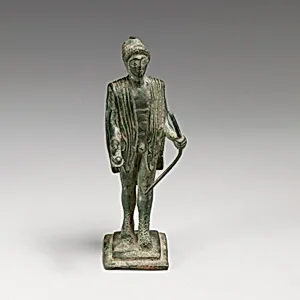
Bronze statuette of Apollo
Unknown Artist
ca. 500 BCE
Medium
Bronze
Dimensions
Overall: 4 3/8 x 5/8 x 2 in. (11.1 x 1.6 x 5.1 cm)
Classification
Bronzes
Culture & Period
Greek · Classical
Department
Greek and Roman Art
Museum
Metropolitan Museum of Art, New York, NY
Credit
Rogers Fund, 1907
Accession Number
07.286.91
Rights
Public Domain
Tags
Art Historical Context
This exquisite bronze statuette of Apollo, dating to around 500 BCE, captures the Greek god of music, prophecy, healing, and the sun during the early Classical period. Standing just 4 3/8 inches tall, this diminutive yet powerful figure exemplifies the transition from the rigid Archaic style to the more naturalistic ideals of Classical Greek art. Crafted by an unknown artist, it likely served as a votive offering in a sanctuary or a personal devotional object, reflecting the deep reverence for Apollo in ancient Greek society. Bronze was a prestigious medium for Greek sculptures, cast using the lost-wax technique, which allowed for intricate details and a lifelike sheen—though few originals survive today, as many were melted down. This statuette's survival highlights its rarity and the Rogers Fund's pivotal role in acquiring it for the Metropolitan Museum of Art in 1907. Its compact form and idealized proportions underscore Apollo's divine beauty and harmony, core tenets of Classical aesthetics. Visitors to the Greek and Roman Art department will appreciate how this piece evokes the vibrant religious life of ancient Greece, where gods like Apollo bridged the mortal and divine worlds. A testament to enduring craftsmanship, it invites us to ponder the artistry of a lost era.