
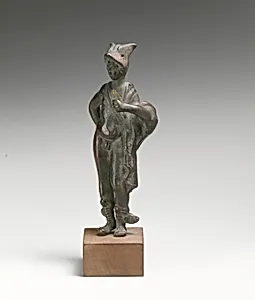
Bronze statuette of Hermes
Unknown Artist
1st century BCE–2nd century CE
Medium
Bronze
Dimensions
H. 5 7/16 in. (13.8 cm)
Classification
Bronzes
Culture & Period
Greek or Roman · Late Hellenistic or Imperial
Department
Greek and Roman Art
Museum
Metropolitan Museum of Art, New York, NY
Credit
Gift of Henry G. Marquand, 1897
Accession Number
97.22.1
Rights
Public Domain
Tags
Art Historical Context
This charming bronze statuette of Hermes standing just 5 7/16 inches (13.8 cm) tall, invites us into the divine world of ancient Greece or Rome. Dating from the 1st century BCE the 2nd century—spanning the Late Hellenistic or Imperial periods—this small-scale figure captures the swift-footed messenger god, known for his winged sandals, caduceus staff, and role as patron of travelers, commerce, heralds. Likely produced as a votive offering or household shrine piece, its modest size made it portable and personal, reflecting everyday devotion in the classical world. Bronze was a prestigious medium in antiquity, valued for its tensile strength and luminous patina, allowing sculptors to render intricate details like flowing drapery and dynamic poses. Crafted by an unknown artist, this work exemplifies the technical mastery of lost-wax casting, a technique that preserved lifelike anatomy and subtle expressions from Hellenistic traditions into Roman times. Many such bronzes survived due to their ritual burial or submersion, evading the melting pots of later eras. A gift to the Metropolitan Museum of Art from Henry G. Marquand in 1897, this Hermes bridges Greek mythology and Roman adaptation, reminding us of the gods' enduring presence in daily life. Gaze upon it and feel the whisper of ancient winds!