
Brooch
Unknown Artist
1000–800 BCE
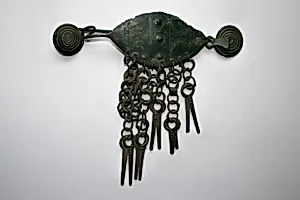
Medium
Copper alloy
Dimensions
Overall: 8 1/4 x 7 1/2 x 13/16 in. (21 x 19 x 2 cm)
Classification
Metalwork-Copper alloy
Culture
European Bronze Age
Department
Medieval Art
Museum
Metropolitan Museum of Art, New York, NY
Credit
Gift of Josef and Brigitte Hatzenbuehler, 2007
Accession Number
2007.498.2
Rights
Public Domain
Tags
Art Historical Context
This striking brooch from the European Bronze Age (1000–800 BCE) exemplifies the era's advanced metalworking prowess. Crafted from copper alloy—a durable material blending copper with tin or other metals for strength—this oversized pin measures an impressive 8¼ x 7½ x 13/16 inches (21 x 19 x 2 cm), suggesting it served not just as a garment fastener but possibly as a badge of status or ritual object. Bronze Age Europeans, from regions like Central or Northern Europe, produced such items during a time of thriving trade networks and technological innovation, when bronze replaced stone tools across the continent. The brooch's design highlights skilled techniques like casting or hammering, common in Late Bronze Age metalwork, allowing for intricate forms that balanced functionality with ornamentation. Brooches like this fastened cloaks or tunics, often worn by elites to display wealth and craftsmanship. Its survival into modern collections underscores the enduring allure of prehistoric artistry. Now housed in the Metropolitan Museum of Art's Medieval Art Department as a gift from Josef and Brigitte Hatzenbuehler in 2007, this anonymous masterpiece invites us to ponder the daily lives and aspirations of our Bronze Age ancestors. (198 words)