
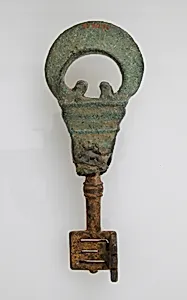
Key with Bow
Unknown Artist
2nd–3rd century
Medium
Copper alloy, iron
Dimensions
Overall: 4 1/2 x 2 1/2 x 11/16 in. (11.5 x 6.4 x 1.8 cm)
Classification
Metalwork-Bronze
Culture
Roman
Department
Medieval Art
Museum
Metropolitan Museum of Art, New York, NY
Credit
Purchase, De Souhami Collection, Rogers Fund, 1906
Accession Number
06.176.66
Rights
Public Domain
Art Historical Context
Step into the daily life of the Roman Empire with *Key with Bow*, a crafted functional object from the 2nd–3rd century. Forged from durable copper alloy—often akin to bronze—and iron, this small key measures just 4½ x 2½ x 11/16 inches, fitting neatly in the hand. Its "bow," or handle, likely featured decorative shaping, blending practicality with subtle artistry typical of Roman metalwork. Created during the height of the Imperial period, when Rome's vast empire demanded secure homes, temples, and treasuries, this key exemplifies late Roman ingenuity in locksmithing. Artisans employed casting and forging techniques to create intricate bits for tumbler locks, showcasing advanced metallurgy that resisted corrosion over centuries. Such objects reveal how everyday Romans valued security amid urban growth and social complexity. Housed in The Metropolitan Museum of Art's Medieval Art Department (reflecting its transition into early medieval contexts), this piece from the 1906 De Souhami Collection and Rogers Fund purchase offers a tangible glimpse into ancient craftsmanship. Though by an unknown maker, it underscores the cultural importance of humble tools as windows into Roman innovation and resilience.