
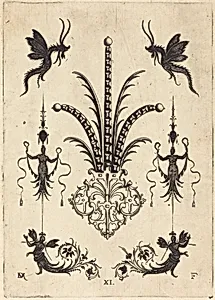
Brooch with Table-Stones, Winged Animals at Top, and Winged Human Beings at Bottom
1596
Medium
engraving
Classification
Department
CG-E
Museum
National Gallery of Art, Washington, D.C.
Credit
Rosenwald Collection
Accession Number
1948.11.195
Rights
Public Domain
Art Historical Context
Step into the intricate world of late Renaissance jewelry design with *Brooch with Table-Stones Winged Animals at Top and Winged Human Be at Bottom* (1596), an exquisite engraving by French artist Daniel Mignot. detailed print captures a fantastical brooch adorned witheted table-cut gemstones at its center, flanked by dynamic winged animals—possibly mythical griffins or eagles—perched at the top, and graceful winged human figures, evoking cherubs or putti, supporting the base. Mignot, a skilled goldsmith and engraver specialized in ornamental patterns that bridged art and craftsmanship during the Mannerist era. Created as an engraving—a precise intaglio technique using a burin to incise fine lines into a metal plate—this work served as a model for jewelers across Europe. Its publication in 1596 reflects the opulent tastes of the French court under Henry IV, where elaborate brooches symbolized status and whimsy. The symmetrical composition and fantastical motifs highlight Mannerism's playful distortion of classical forms, blending realism with fantasy to inspire luxurious wearable art. Housed in the National Gallery of Art's Rosenwald Collection (Department CG-E), this print offers a window into how engravings democratized high-end designs, allowing artisans far from Paris to replicate such splendor. Imagine pinning this vision to a velvet doublet— a true jewel of 16th-century ingenuity!
About the Artist
Daniel Mignot · 1593–1616
Daniel Mignot (active 1593–1616) was a French goldsmith and engraver who flourished in the prosperous German city of Augsburg, a hub for ornamental metalwork during the late Renaissance. Presumably of Huguenot origins, he relocated from France amid religious tensions, establishing himself as a specialist in intricate jewelry designs. His early life remains not well documented, with no records of s...