
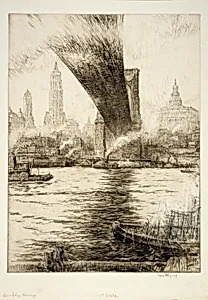
Brooklyn Bridge
ca. 1930
Medium
Graphic Arts-Print
Classification
Graphic Arts-Print
Department
Smithsonian Collection
Museum
Smithsonian American Art Museum
Credit
Smithsonian American Art Museum, Gift of Mr. and Mrs. Harry Katz
Accession Number
1971.407
Rights
Public Domain
Tags
Art Historical Context
Kerr Eby's *Brooklyn Bridge* (ca. 1930) captures the majestic span of one of New York's most iconic in a delicate etching, a graphic arts print from the Smithsonian American Art Museum collection. Eby, a master American printmaker renowned for his atmospheric landscapes and urban scenes, renders the East River bustling with a riverboat below the towering Gothic arches. Donated as a gift from Mr. and Mrs. Katz, this work exemplifies the precision and tonal depth of early 20th-century printmaking. Eby's etching technique shines here, using intricate line work and subtle aquatint to evoke the bridge's steel grandeur against misty skies and rippling waters. As part of the interwar print revival, his realistic style—rooted in the Ashcan School's urban grit—made fine art accessible through affordable reproductions, bridging elite galleries and everyday viewers during the Great Depression. Historically, the Brooklyn Bridge, completed in 1883, symbolized American ingenuity and immigration dreams by the 1930s. Eby's view highlights its enduring role as a gateway between Manhattan and Brooklyn, blending industrial might with the East River's lively traffic—a timeless nod to New York's vibrant pulse.
About the Artist
Kerr Eby · 1889–1946
Kerr Eby (1889–1946) was a Canadian-born American printmaker and painter who became one of the most accomplished etchers of his generation and a powerful chronicler of the experience of war. Born in Tokyo to Canadian parents, he grew up in New York and studied at the Pratt Institute and the Art Students League under George Bridgman. Eby volunteered for service in World War I and saw action in Fra...