
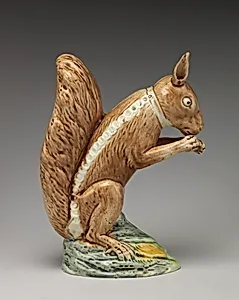
Brown squirrel with collar and chain
ca. 1770–80
Medium
Lead-glazed earthenware
Dimensions
Height: 7 in. (17.8 cm)
Classification
Ceramics-Pottery
Culture
British, Burslem, Staffordshire
Department
European Sculpture and Decorative Arts
Museum
Metropolitan Museum of Art, New York, NY
Credit
Gift of Mrs. Russell S. Carter, 1945
Accession Number
45.12.86
Rights
Public Domain
Tags
Art Historical Context
This charming figure of a brown squirrel, crafted around 1770–80 by Ralph Wood the Younger in Burslem, Staffordshire, captures the playful spirit of British decorative arts during the late eighteenth century. Standing just seven inches tall, the lead-glazed earthenware sculpture shows the squirrel wearing a delicate collar and chain, suggesting it was modeled after a beloved household pet. Wood, part of a renowned family of Staffordshire potters, specialized in such whimsical animal forms that brought a touch of nature into Georgian homes. Staffordshire potteries like those in Burslem thrived on producing affordable yet finely modeled figures using lead glazes that yielded rich, earthy tones. This piece reflects the period’s growing fascination with natural history and domestic animals, as well as the technical skill required to shape and fire small-scale ceramics with lively expressions and textured details. Its modest size made it ideal for display on mantelpieces or shelves, where it could delight viewers with its lifelike charm. Today, the work resides in the Metropolitan Museum of Art’s collection of European Sculpture and Decorative Arts, a gift that preserves a delightful example of regional British craftsmanship from the Age of Enlightenment.
About the Artist
Ralph Wood the Younger · 1748–1795
Ralph Wood the Younger was born in Burslem, Staffordshire, in 1748, the son of the celebrated potter Ralph Wood the Elder and a member of a family that stood at the center of the Staffordshire ceramics industry during its most creative and internationally influential period. Growing up in the workshops of his father, he absorbed from childhood the technical traditions of English earthenware produc...