
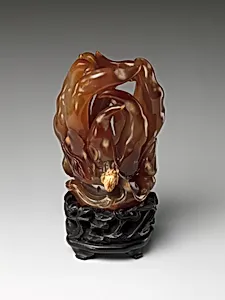
清 瑪瑙佛手擺件|Buddha’s hand
Unknown Artist
18th century
Medium
Carnelian
Dimensions
H. 4 in. (10.2 cm)
Classification
Hardstone
Culture & Period
China · Qing dynasty (1644–1911)
Department
Asian Art
Museum
Metropolitan Museum of Art, New York, NY
Credit
Gift of Heber R. Bishop, 1902
Accession Number
02.18.885
Rights
Public Domain
Tags
Art Historical Context
This exquisite carnelian Buddha’s hand ornament, carved in 18th-century Qing dynasty China, captures the fruit’s distinctive, finger-like segments in remarkable detail. Standing just 4 inches (10.2 cm) tall, the piece is fashioned from a single block of red carnelian—a semiprecious hardstone prized for its warm translucency and durability. Qing artisans excelled in such intricate hardstone carvings, transforming raw minerals into lifelike scholar’s objects or display pieces (摆件) through meticulous techniques like incising veins, polishing surfaces to a high gloss, and hollowing interiors for realism. Known as *fo shou* in Chinese, the Buddha’s hand citron symbolizes *fu* (wealth) and *shou* (longevity), embodying auspicious wishes for prosperity and long life—core values in imperial and scholarly culture. During the Qing era (1644–1911), such carvings were popular among elites, often placed on desks or altars to invoke good fortune. This example, gifted to the Metropolitan Museum of Art by Heber R. Bishop in 1902, exemplifies the dynasty’s mastery of hardstone sculpture, rivaling jade in finesse and evoking nature’s bounty in enduring stone. A delightful fusion of artistry and symbolism, it invites visitors to ponder the elegance of everyday abundance.