
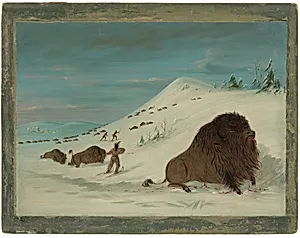
Buffalo Lancing in the Snow Drifts - Sioux
1861/1869
Medium
oil on canvas mounted on paperboard
Dimensions
overall: 45.9 x 63.8 cm (18 1/16 x 25 1/8 in.)
Classification
Painting
Department
CAB
Museum
National Gallery of Art, Washington, D.C.
Credit
Paul Mellon Collection
Accession Number
1965.16.345
Rights
Public Domain
Art Historical Context
George Catlin's *Buffalo Lancing in the Snow Drifts - Sioux* (1861/1869) captures a dramatic moment in Plains Indian life: Sioux hunters pursuing buffalo through treacherous winter snowdrifts using traditional lances. Painted in oil on canvas mounted on paperboard (45.9 x 63.8 cm), this work exemplifies Catlin's lifelong passion for documenting Native American cultures before they were profoundly changed by European expansion. A pioneering artist and ethnographer, Catlin traveled the American West in the 1830s, creating over 600 paintings that form one of the earliest visual records of tribal customs, dress, and daily survival. The scene highlights the buffalo's central role in Sioux sustenance and spirituality, as these massive herds provided food, clothing, and tools. Catlin's realistic style, rooted in 19th-century American Romanticism, conveys the raw intensity of the hunt amid a stark, snowy landscape, emphasizing both human skill and nature's harsh beauty. This later-dated piece, part of the Paul Mellon Collection at the National Gallery of Art, reflects Catlin's efforts to replicate and preserve his original sketches for wider audiences. Through vivid brushwork and dynamic composition, the painting immerses viewers in a vanishing world, underscoring the cultural urgency of Catlin's mission and the artistry in portraying Indigenous resilience.
About the Artist
George Catlin · 1796–1872
George Catlin (1796–1872), born in Wilkes-Barre, Pennsylvania, to Putnam Catlin and Polly Sutton—who had been captured by Native Americans during the 1778 Battle of Wyoming—initially pursued a legal career. Trained at Litchfield Law School, he was admitted to the bar in 1819 but abandoned law after two years to study art in Philadelphia in 1823. Self-taught as a portraitist, Catlin quickly gained ...