
Bug-Jargal
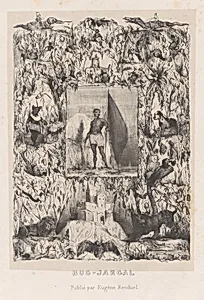
Medium
Etching
Dimensions
Plate: 9 5/16 × 6 1/4 in. (23.7 × 15.8 cm) Sheet: 10 9/16 × 6 3/4 in. (26.9 × 17.2 cm)
Classification
Prints
Department
Drawings and Prints
Museum
Metropolitan Museum of Art, New York, NY
Credit
The Elisha Whittelsey Collection, The Elisha Whittelsey Fund, 1929
Accession Number
29.18.4(4)
Rights
Public Domain
Art Historical Context
In the early 1830s, amid the fervor of French Romanticism, Victor Hugorenowned novelist and poet—collaborated with illustrators Célestin Nuil and Eugène Rend on *Bug-Jargal*, an etching that captures the dramatic spirit of Hugo's 1826 novel of the same name. The work depicts a pivotal scene from the story, set against the backdrop of the Haitian Revolution1791–1804), where the titular character, a noble Haitian slave leader, embodies themes of rebellion, honor, and colonial injustice. This print reflects Romanticism's passion for exoticism, heroism, and social upheaval, bridging literature and visual art in an era when authors like Hugo actively shaped illustrated editions of their works. Etched on a modest plate measuring 9 5/16 × 6 1/4 inches, the technique allowed for intricate lines and rich tonal contrasts, ideal for conveying emotional intensity and narrative detail. Etching, popular in 19th-century France for book illustrations and affordable reproductions, democratized art, making literary imagery accessible beyond elite circles. Housed in the Metropolitan Museum of Art's Drawings and Prints department as part of The Elisha Whittelsey Collection (acquired 1929), *Bug-Jargal* stands as a testament to interdisciplinary creativity, highlighting Hugo's influence across mediums during a transformative period in European culture.