
Satan Smiting Job with Boils
1825
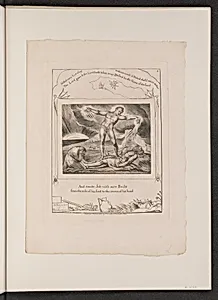
Medium
engraving on thick paper
Classification
Portfolio
Department
CG-E
Museum
National Gallery of Art, Washington, D.C.
Credit
Rosenwald Collection
Accession Number
1943.3.1677
Rights
Public Domain
Art Historical Context
William Blake's *Satan Smiting Job Boils* (1825) is a powerful engraving from his monumental series *Illustrations of the Book of Job*, a set of 22 plates that reinterpret the biblical tale of suffering and divine testing. Depicting the moment when Satan afflicts the righteous Job with painful boils as described in the Book of Job (2:7), the image captures Blake's visionary intensity, blending human anguish with supernatural menace. Created during the late Romantic period, it reflects Blake's lifelong fascination with spiritual struggle, prophecy, and the sublime. Printed as a relief etching on thick laid paper—a technique Blake pioneered in his "illuminated printing" method—this work showcases his mastery of line and tonal contrast. The dense, swirling forms and dramatic chiaroscuro evoke both physical torment and metaphysical drama, distinguishing Blake from contemporaries like his rival engravers. Part of the National Gallery of Art's Rosenwald Collection (Department CG-E, Portfolio classification), it exemplifies how Blake fused poetry, mysticism, and printmaking to challenge conventional religious iconography. This engraving invites visitors to ponder timeless questions of faith amid adversity, a hallmark of Blake's enduring legacy as a poet-artist who saw art as a divine revelation.
About the Artist
William Blake · 1757–1827
William Blake (1757–1827) stands as one of the most visionary and unconventional artists in British history, a poet-painter-printmaker whose mystical imagination and radical vision profoundly shaped the Romantic movement. Born in London's Soho district, Blake experienced visions from childhood—claiming to see angels in trees at age eight—and these spiritual encounters would guide his art throughou...