
Bugaku Dancers
Medium
Six-panel screen; ink, color, and gold on gilded paper
Dimensions
Image: 69 3/8 in. × 12 ft. 2 3/8 in. (176.2 × 371.8 cm)
Classification
Paintings
Culture & Period
Japan · Edo period (1615–1868)
Department
Asian Art
Museum
Metropolitan Museum of Art, New York, NY
Credit
Gift of James L. Greenfield, in memory of Margaret Greenfield, 2000
Accession Number
2000.453
Rights
Public Domain
Tags
Art Historical Context
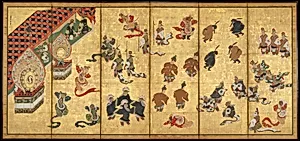
This six-panel folding screen Kano Yasunobu captures graceful movements of Bugaku dancers accompanied by drummers, a ceremonial court dance with roots in ancient continental traditions that became central to Japanese imperial rituals. Created during the Edo period (1615–1868), the work reflects the refined tastes of the era’s elite, when such performances symbolized harmony, hierarchy, and cultural continuity at the imperial court. Yasunobu, a leading figure in the renowned Kano school of painters, specialized in large-scale decorative works that blended narrative detail with elegant stylization. The screen’s medium—ink, color, and gold on gilded paper—highlights the Kano school’s signature technique of applying gold leaf to create luminous backgrounds that make figures appear to float against a shimmering expanse. This approach not only enhanced the visual drama of the dancers’ flowing robes and precise gestures but also suited the screens’ practical role as room dividers in dimly lit interiors. The result is both a vivid record of a living tradition and a masterful example of how Japanese artists transformed ceremonial subjects into objects of refined beauty.
About the Artist
Kano Yasunobu (Japanese) · 1614 –1685
Japanese, 1614–1685