
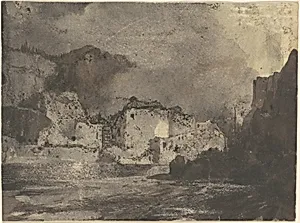
Buildings by Moonlight
c. 1875
Medium
black ink wash and watercolor on wove paper
Dimensions
sheet: 13.02 × 17.62 cm (5 1/8 × 6 15/16 in.)
Classification
Drawing
Department
CG-W
Museum
National Gallery of Art, Washington, D.C.
Credit
Corcoran Collection (Gift of Milch Galleries)
Accession Number
2015.19.604
Rights
Public Domain
Art Historical Context
Thomas Moran's *Buildings by Moonlight*c. 1875) captures a serene nocturnal urban scene, rendered in delicate black ink wash and watercolor wove paper. Measuring just 13 × 18 cm, this intimate drawing showcases the artist's mastery of light and shadow, with moonlight bathing architectural forms in a soft, ethereal glow. Moran, leading figure in the Hudson River and celebrated for his dramatic landscapes of the American West demonstrates his versatility here, shifting from vast wilderness to the quiet poetry of man-made structures under night skies. The mixed media technique is key to its luminous effect: ink wash provides fluid tonal depth and subtle gradations, mimicking the moon's diffuse light, while watercolor adds translucent hues for atmospheric mood. Wove paper, smooth and absorbent, was ideal for such precise washes, allowing Moran to blend precision with spontaneity—a hallmark of 19th-century sketchbooks used by artists on travels or in studios. Part of the Corcoran Collection at the National Gallery of Art, this work reflects the era's fascination with Romantic nocturnes amid America's Gilded Age urbanization. It invites visitors to ponder how Moran, famed for inspiring Yellowstone's preservation, also found beauty in everyday built environments, bridging nature's grandeur with human habitation.
About the Artist
Thomas Moran · 1837–1926
Thomas Moran (1837–1926) was an American painter and printmaker of the Hudson River School whose dramatic paintings of the American West played a pivotal role in the creation of the national parks. Born in Bolton, Lancashire, England, he emigrated with his family to Philadelphia as a child. He was largely self-taught, though he apprenticed briefly with a wood engraver and studied the work of J.M.W...