
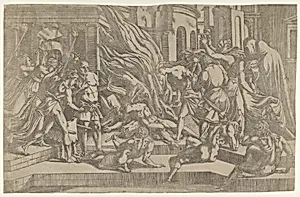
Burning of a corpse
Medium
Etching
Dimensions
Sheet (trimmed): 10 1/4 × 15 13/16 in. (26 × 40.2 cm)
Classification
Prints
Department
Drawings and Prints
Museum
Metropolitan Museum of Art, New York, NY
Credit
The Elisha Whittelsey Collection, The Elisha Whittelsey Fund, 1949
Accession Number
49.97.587
Rights
Public Domain
Tags
Art Historical Context
In the mid-16th century, the opulent era of France's Fontainebleau School, Italian Mannerist artist Rosso Fiorentino with engraver Antonio Fantuzzi to produce striking etchings that blended dramatic Italian style with French Renaissance elegance. Created between 1540 and 1545, *Burning of a Corp* exemplifies this fusion, capturing a macabre public spectacle through intricate lines on a trimmed sheet measuring 10¼ × 15⅞ inches. Housed in the Metropolitan Museum of Art's Drawings and Prints department, this work was made possible by The Elisha Whittelsey Collection. Etching, a revolutionary printmaking technique at the time, allowed Fantuzzi to translate Rosso's bold, elongated figures and turbulent compositions with remarkable precision and tonal depth. The scene depicts a crowd gathered around a blazing pyre consuming a corpse, evoking themes of mortality, punishment, or ritual that resonated in an age of religious upheaval and public executions. Rosso's Mannerist influence shines through in the exaggerated poses and emotional intensity, making the print not just a reproduction but a powerful narrative tool disseminated widely across Europe. This etching offers a window into the Fontainebleau court's fascination with the grotesque and the sublime, inviting viewers to ponder life's fragility amid the flames. A testament to collaborative genius, it remains a highlight of 16th-century graphic art.
About the Artist
Antonio Fantuzzi|Rosso Fiorentino · 1537–1545
**Antonio Fantuzzi** (active 1537–1550) was an Italian painter and printmaker born in Bologna who played a significant role in the First School of Fontainebleau during the French Renaissance. He worked in a Mannerist style, contributing to the lavish decorations of the Palace of Fontainebleau under royal patronage. Fantuzzi is recorded as a painter at Fontainebleau from 1537 onward, initially on ...