
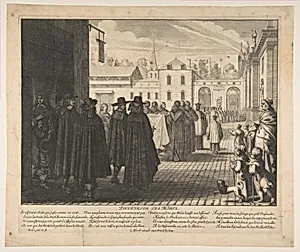
Burying the Dead
Medium
Etching with engraving
Dimensions
Sheet: 11 3/8 x 13 1/2 in. (28.9 x 34.3 cm) Plate: 10 1/4 × 12 5/16 in. (26 × 31.3 cm)
Classification
Prints
Department
Drawings and Prints
Museum
Metropolitan Museum of Art, New York, NY
Credit
Harris Brisbane Dick Fund, 1926
Accession Number
26.49.21
Rights
Public Domain
Tags
Art Historical Context
In the etching *Burying the Dead (1635), French printmakers Abraham Bosse and Jean Iblond capture a haunting moment of communal grief and mortality. Bosse, a master of the 17th reproductive print, often collaborated with engravers like Leblond to paintings or designs into intricate prints. Created during the turbulent era of the Thirty Years', when plagues and battles ravaged Europe, this work evokes the era's preoccupation with death and human resilience. The scene features men and women tenderly burying the dead, with the striking presence of lions adding a layer of enigma—perhaps symbolizing ferocity, exotic danger, or biblical undertones amid the tragedy. Rendered in etching with engraving on a modest sheet (11 3/8 x 13 1/2 in.), the technique blends etching's spontaneous, fluid lines for expressive figures with engraving's precise detailing for textures like drapery and ground. This hybrid method was revolutionary, enabling affordable dissemination of poignant narratives to a wide audience. Housed in the Metropolitan Museum of Art's Drawings and Prints department (Harris Brisbane Dick Fund, 1926), the print exemplifies how 17th-century artists used prints to confront viewers with life's fragility, blending realism with subtle allegory for enduring emotional impact.
About the Artist
Abraham Bosse|Jean I Leblond · 1602–1676
Abraham Bosse (1604–1676) was a French printmaker and theorist whose approximately 1,600 etchings provide an unparalleled visual record of 17th-century French life. Born to Huguenot parents in Tours, he trained in Paris under Melchior Tavernier and became a devoted follower of Jacques Callot's technical innovations. Bosse's meticulous etchings depicted subjects ranging from daily life and fashion ...