
Bust of a Roman emperor, probably Emperor Domitian (r. 81–96 A.D)
18th century
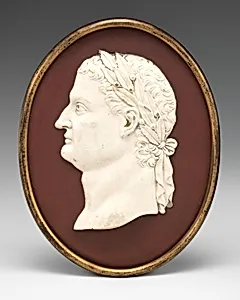
Medium
White jasper
Dimensions
3 3/4 × 2 1/2 in. (9.5 × 6.4 cm)
Classification
Ceramics-Pottery
Culture
British, Etruria, Staffordshire
Department
European Sculpture and Decorative Arts
Museum
Metropolitan Museum of Art, New York, NY
Credit
Rogers Fund, 1909
Accession Number
09.194.16a
Rights
Public Domain
Tags
Art Historical Context
This exquisite bust, likely portraying the Roman Emperor Domitian (r. 81–96 A.D.), captures the stern profile of one of ancient Rome's most controversial rulers, known for his authoritarian style and eventual damnatio memoriae by the Senate. Crafted in the 18th century Josiah Wedgwood, the British potter from Staffordshire's Etruria factory, exemplifies the neoclassical revival that swept Europe. Visitors admire how Wedgwood drew from excavated Roman antiquities, blending historical reverence with innovative craftsmanship. Made of white jasper—a fine, unglazed stoneware Wedgwood perfected around 1775—this small-scale ceramic (just 3¾ × 2½ inches) mimics the matte elegance of ancient cameos and porphyry portraits. Its crisp relief profile highlights Wedgwood's mastery of bas-relief techniques, achieved by layering and firing colored clays into a durable, jewel-like body. Part of the Metropolitan Museum of Art's European Sculpture and Decorative Arts collection, this piece underscores ceramics' rise as high art, bridging ancient imperial power with Enlightenment-era fascination for classical antiquity. A testament to Wedgwood's industrial genius, it invites us to ponder emperors long vilified, preserved in timeless porcelain.
About the Artist
Josiah Wedgwood · 1730–1795
Josiah Wedgwood (1730–1795) was born in Burslem, Staffordshire, the thirteenth child of a potter whose family had worked in the craft since the seventeenth century. Apprenticed to his elder brother Thomas following their father's death, he went on to a partnership with Thomas Whieldon of Fenton — the most respected potter in England at the time — which gave him command of all the principal techniq...