
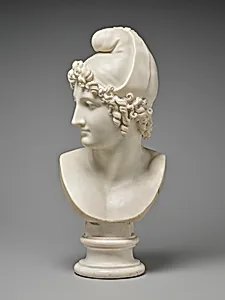
Bust of Paris
1809
Medium
Marble
Dimensions
69.9 × 30.8 × 28 cm (27 1/2 × 12 1/8 × 11 in.); With socle: 134.7 × 58.5 cm (53 × 23 in.)
Classification
bust/head
Department
Painting and Sculpture of Europe
Museum
Art Institute of Chicago
Accession Number
102591
Rights
Public Domain
About this artwork
The enormously popular Neoclassical sculptor Antonio Canova frequently made replicas or variants of his major works to satisfy the demand for his art. While executing a commission from Empress Josephine of France for a full-length statue of Paris (State Hermitage Museum, Saint Petersburg), Canova carved this bust for his friend Antoine Quatremère de Quincy, a French Neoclassical theorist and critic who greatly influenced the sculptor’s artistic ideals. It depicts the moment in Greek mythology whe...
Art Historical Context
Antonio Canova’s *Bust of Paris*, carved in 1809, captures the Trojan prince from Greek mythology with the refined elegance that made the Italian sculptor one of the foremost figures of the Neoclassical movement. Working in marble, Canova achieved the smooth, luminous surfaces and crisp details that recall ancient Roman portraiture while infusing the figure with a quiet, introspective dignity. The bust’s modest scale—roughly life-size without its socle—invites visitors to study the subtle modeling of the face and the carefully rendered curls, hallmarks of Canova’s ability to breathe life into stone. Created at the height of Canova’s international fame, the work reflects the early nineteenth-century fascination with classical antiquity. European collectors and patrons prized such marble busts both as emblems of refined taste and as modern interpretations of ideals handed down from antiquity. Today, this sculpture in the Art Institute of Chicago’s collection of European Painting and Sculpture offers viewers a tangible link to that era’s dialogue between past and present, demonstrating how Canova transformed a familiar mythological subject into an object of timeless serenity.
About the Artist
Antonio Canova · 1757–1822
Antonio Canova, born on November 1, 1757, in the small town of Possagno in the Republic of Venice, was immersed in sculpture from childhood. His father, Pietro Canova, a stonecutter, died when Antonio was just four, prompting his mother, Angela Zardo Fantolin, to remarry and place him under the care of his paternal grandfather, Pasino Canova. A skilled stonemason and sculptor of late Baroque altar...