
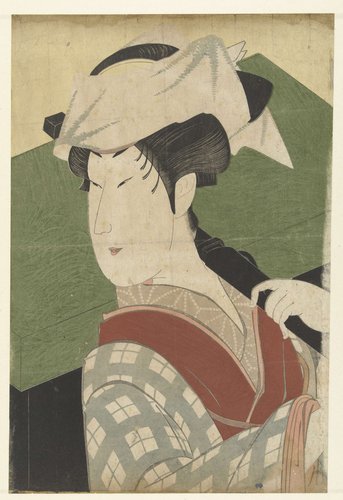
Busteportret van Nakamura Noshio II
1795
Medium
nishiki-e
Dimensions
378; 251
Rights
Public Domain
About this artwork
Aankoop met steun van de Vereniging Rembrandt en het Ministerie van Onderwijs, Kunsten en Wetenschappen
Art Historical Context
This exquisite *Busteportret van Nakamura Noshio* (Bust Portrait of Nakamura Nio II), created by Utagawa Kunasa in 1795, captures the charisma of a prominent kabuki actor during Japan's Edo period. Kunimasa, a skilled member of the Utagawa school, specialized yakusha-e—vibrant prints portraying theater stars as cultural icons. Nakamura Noshio II, depicted in a close-up bust format, embodies the dramatic flair of kabuki, where actors were celebrities of the "floating world" (ukiyo), blending artistry with everyday entertainment. Printed as a nishiki-e, or "brocade picture," this woodblock print measures 378 × 251 mm and showcases the revolutionary multicolored technique perfected in the late 18th century. Layers of intricate color blocks created luxurious, vivid effects, making such prints accessible yet opulent for urban audiences in Edo (modern Tokyo). This medium democratized celebrity portraits, fueling a craze for actor imagery that influenced global art. Acquired with support from the Vereniging Rembrandt and the Dutch Ministry of Education, Arts and Sciences, this work highlights the cross-cultural appreciation of ukiyo-e. It invites us to marvel at how 18th-century Japanese printmakers preserved the ephemeral thrill of live performance for posterity.
About the Artist
Utagawa Kunimasa · 1773–1810
Utagawa Kunimasa (1773–1810) was a Japanese ukiyo-e artist specializing in yakusha-e, or Kabuki actor prints, during the late Edo period. Born in Aizu, Fukushima Prefecture in 1773, Kunimasa initially worked in a local dye factory for several years before pursuing his true passion. As an ardent Kabuki theatre enthusiast, he relocated to Edo (modern Tokyo) to establish himself as an artist capable ...