
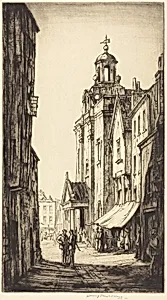
Butter Cross, Ludlow
1919
Medium
drypoint in black
Dimensions
plate: 30.2 × 17 cm (11 7/8 × 6 11/16 in.)
Classification
Department
CG-W
Museum
National Gallery of Art, Washington, D.C.
Credit
Rosenwald Collection
Accession Number
1943.3.7515
Rights
Public Domain
Art Historical Context
Henry Rushbury's *Butter Cross, Ludlow (1919) captures timeless charm of a historic market cross in the English town of Ludlow, Shropshire. This drypoint print showcases Rushbury's mastery as a British topographical artist, who documented architectural landmarks with precise yet atmospheric detail. Created just after World War I, work reflects a nostalgic gaze on England's rural heritage amid rapid modernization, preserving the Butter Cross—a medieval structure once used for butter trading—as a symbol of communal life. The medium of drypoint, etched directly into a metal plate with a sharp tool, lends the image its signature velvety texture and rich black tones. Unlike smoother etching techniques, drypoint's burr creates soft, expressive lines that evoke depth and shadow, making this intimate plate (30.2 × 17 cm) feel monumental. Rushbury, influenced by masters like Whistler, elevated printmaking to fine art, blending realism with subtle impressionism. Housed in the National Gallery of Art's Rosenwald Collection, this print invites visitors to appreciate how everyday English history endures in ink. A perfect gem for lovers of architectural whimsy!
About the Artist
Henry Rushbury · 1889–1968
Henry Rushbury was a British artist celebrated primarily for his etchings and watercolors of architectural subjects, working during the early and middle decades of the twentieth century. He studied at the Birmingham School of Art before moving to London, where he became part of a generation of printmakers who revitalized the etching medium in Britain during the years surrounding the First World Wa...