
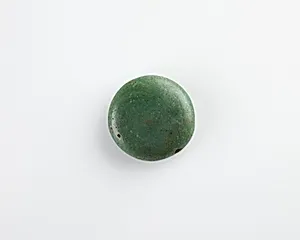
Button bead
305 BCE-14 CE
Classification
Jewelry and Ornament
Department
Smithsonian Collection
Museum
Smithsonian American Art Museum
Credit
Gift of Charles Lang Freer
Accession Number
F1909.757
Rights
Public Domain
Tags
About this artwork
To 1909
Art Historical Context
This delicate **Button Bead**, crafted from glass during Egypt's Ptolemaic Dynasty305–30 BCE) and into the early Roman Period (up to 14 CE), a glimpse into the everyday artistry of ancient Egypt. Produced in a time when Greek rulers blended with pharaonic traditions under the Ptolemies, and later Roman influence took hold, such beads were essential components of jewelry and ornaments. Worn as fasteners or decorative accents on clothing and accessories, they highlight the era's fusion of cultures in the Nile Valley. Glassmaking flourished in Egypt during this period, with artisans employing sophisticated techniques like core-forming or molding to create vibrant, durable objects from silica sands. Though small, this bead exemplifies the precision and accessibility of Ptolemaic-Roman crafts, where glass production supported both elite adornments and common trade goods. Its survival speaks to the resilience of these artifacts, traded across the Mediterranean. Acquired by collector Charles Lang Freer before 1909 and gifted to the Smithsonian, this piece from the Smithsonian American Art Museum's collection invites us to ponder the lives of ancient Egyptians—practical yet beautiful in their ingenuity. (198 words)
About the Artist
Unknown
The artist designated as "Unknown" in our virtual museum's collection exemplifies a poignant chapter in art history: creators whose identities have faded into obscurity despite the enduring power of their work. With only one known artwork attributed to them in our holdings, this figure represents countless anonymous hands that shaped visual culture across centuries. Museums worldwide, including th...