
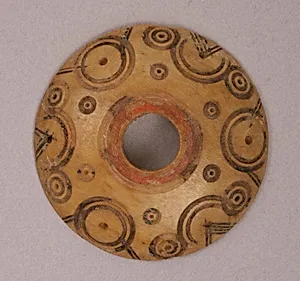
Button or Spindle Whorl
Unknown Artist
9th–10th century
Medium
Bone; incised and inlaid with paint
Dimensions
H. 3/16 in. (0.5 cm) Diam. 15/16 in. (2.4 cm)
Classification
Ivories and Bone
Department
Islamic Art
Museum
Metropolitan Museum of Art, New York, NY
Credit
Rogers Fund, 1938
Accession Number
38.40.50
Rights
Public Domain
Art Historical Context
This delicate button or spindle whorl crafted from bone in the 9th–10th century, offers a glimpse into the everyday artistry of the Islamic world during the Abbas era. Measuring just under an inch in diameter and a mere 3/16 inch high, such diminutive objects were essential tools: a spindle whorl weighted yarn for spinning thread, while a button secured clothing. Housed in the Metropolitan Museum of Art's Islamic department (acquired via the Rogers Fund in 193), it exemplifies how commonplace items were transformed into finely wrought treasures. The object's medium—bone, incised with intricate lines and inlaid with paint—highlights masterful craftsmanship. Incising involved carving precise motifs into the hard surface, then filling them with colored pigments for vibrant contrast, a technique that ensured durability and visual appeal despite daily use. This method was widespread in Islamic ivories and bonework, blending functionality with subtle decoration often featuring geometric or floral patterns suited to portable, personal items. Beyond its utility, this whorl reflects the cultural sophistication of medieval Islamic society, where even humble tools bore traces of artistic refinement. It invites us to appreciate the skilled, anonymous artisans whose work wove beauty into the fabric of daily life.