
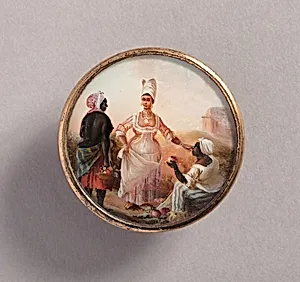
Button
late 18th century
Medium
costume & accessories
Classification
costume & accessories
Department
Smithsonian Collection
Museum
Smithsonian American Art Museum
Credit
Gift of R. Keith Kane from the Estate of Mrs. Robert B. Noyes
Accession Number
1949-94-12
Rights
Public Domain
About this artwork
Research in Progress
Art Historical Context
This modest yet intriguing *Button* by Agostino Brunias (Italian, ca. 1730–1796) offers a glimpse into late 18th-century fashion and craftsmanship. Brunias, best known for his colorful oil paintings capturing daily life among free people of color and enslaved communities in the British West Indies, occasionally ventured into smaller-scale works. Produced during his active years in the Caribbean (1770s–1790s), this accessory reflects the era's decorative costume elements, where buttons served not just as fasteners but as subtle displays of status and artistry. As a piece in the costume and accessories category, it exemplifies the intricate materials and designs popular among colonial elites and traders. Such items were often handmade, incorporating metals, fabrics, or enamels, and traded across Atlantic networks linking Europe, the Americas, and the Caribbean. Its inclusion in the Smithsonian American Art Museum's collection—gifted by R. Keith Kane from the Estate of Mrs. Robert B. Noyes—highlights its value within American cultural history, bridging fine art and everyday objects. Currently under research, this button invites visitors to ponder Brunias's versatility and the hidden stories in personal adornments. What tales of travel, trade, or identity might it hold? A small artifact with big historical echoes.