
Byzantine Dome Coin Bank
c. 1938
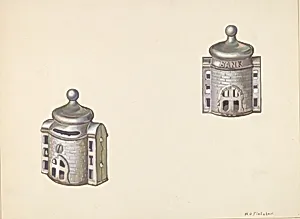
Medium
watercolor, gouache, and graphite on paper
Dimensions
overall: 21.5 x 29.1 cm (8 7/16 x 11 7/16 in.) Original IAD Object: 3 3/4" high, 2 7/16" wide; 1 7/8" deep
Classification
Index of American Design
Department
CG-W
Museum
National Gallery of Art, Washington, D.C.
Credit
Index of American Design
Accession Number
1943.8.8501
Rights
Public Domain
Art Historical Context
This delicate rendering captures a charming coin bank shaped like a miniature Byzantine dome, standing just 3¾ inches tall. Created around 1938 by William O. Fletcher, the work belongs to Index of American Design, a New Deal initiative that employed artists to document everyday American decorative objects for posterity. The bank’s rounded, onion-shaped form and intricate surface details evoke the architectural splendor of Eastern Orthodox churches, translated here into a playful savings vessel likely produced in the early twentieth century. Fletcher rendered the object with watercolor, gouache, and graphite on paper, a combination that allowed for both precise architectural lines and soft tonal modeling. The careful shading emphasizes the dome’s curved volume and the subtle textures of its painted or molded surface, giving viewers an almost tactile sense of the original metal or ceramic artifact. Such meticulous technique was essential to the Index’s mission of preserving visual records of American craft traditions before they disappeared. Today this drawing serves as both artwork and historical document, illustrating how ordinary household items once borrowed motifs from grand architectural styles. Displayed at the National Gallery of Art, it invites visitors to appreciate the quiet creativity embedded in everyday American design.
About the Artist
William O. Fletcher · 1880–1954
William O. Fletcher is represented in museum collections by a body of work that demonstrates consistent artistic output and the kind of sustained production that distinguishes professional or semi-professional practice from occasional art-making. While his biographical details remain unrecorded in the sources readily available to researchers — his dates, nationality, and training all currently unk...