
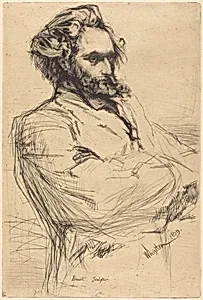
C. L. Drouet, Sculptor
Medium
drypoint on Asian laid paper
Dimensions
plate: 22.54 x 15.24 cm (8 7/8 x 6 in.) sheet: 27.94 x 20.32 cm (11 x 8 in.)
Classification
Department
CG-W
Museum
National Gallery of Art, Washington, D.C.
Credit
Rosenwald Collection
Accession Number
1943.3.8659
Rights
Public Domain
Art Historical Context
James McNeill Whistler’s *C. L. Drouet, Sculptor* (1859) captures the essence of artistic camaraderie in mid-19th-century Paris. Created during Whistler’s formative years abroad, this intimate portrait depicts Charles-Louis Drouet, a fellow sculptor and friend, rendered with a direct gaze and thoughtful pose. As Whistler transitioned from his American roots to European influences, works like this reflect his early immersion in Realism, inspired by masters like Courbet, while foreshadowing his lifelong pursuit of harmony and subtlety in art. Executed in drypoint—a technique where the artist scratches lines directly into a copper plate with a sharp tool—this print produces rich, velvety burrs of ink that lend a painterly depth unmatched by etching. Printed on Asian laid paper, prized for its soft texture and absorbency, the work exemplifies Whistler’s innovative approach to printmaking, emphasizing tonal nuance over precise detail. Measuring a modest plate size of 22.54 x 15.24 cm, it invites close viewing to appreciate the delicate ink variations. Housed in the National Gallery of Art’s Rosenwald Collection, this piece highlights Whistler’s pivotal role in elevating prints to fine art status. Part of his acclaimed early series, it offers a window into the bohemian art world, blending portraiture with technical bravura for enduring appeal.
About the Artist
James McNeill Whistler · 1834–1903
James Abbott McNeill Whistler (1834-1903) was an American-born painter and printmaker who became a leading figure in the Aesthetic Movement and pioneer of Tonalism and Japonisme. He revolutionized art by championing "art for art's sake" and treating paintings as visual equivalents of musical compositions, titling works as "arrangements," "harmonies," and "nocturnes" to emphasize formal qualities o...