
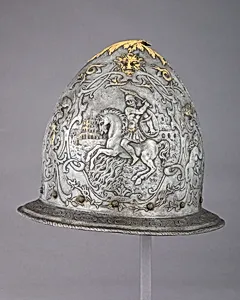
Cabasset in Late 16th Century French Style
Unknown Artist
ca. 1870
Medium
Steel, gold, leather
Dimensions
H. 8 3/4 in. (22.2 cm); W. 8 1/2 in. (21.6 cm); D. 10 in. (25.4 cm); Wt. 3 lb. 8 oz. (1600 g)
Classification
Forgeries
Culture
French
Department
Arms and Armor
Museum
Metropolitan Museum of Art, New York, NY
Credit
Gift of William H. Riggs, 1913
Accession Number
14.25.622
Rights
Public Domain
Tags
Art Historical Context
Step into the Arms and Armor gallery to admire this striking *Cabasset in Late 16th Century Style*, a steel helmet forged around 1870 to evoke the rugged defenses of Renaissance warriors. Measuring just 8¾ inches high and weighing a sturdy 3 pounds 8 ounces, this close-fitting morion-style helm features a peaked skull designed to deflect blows from swords or pikes—ideal for 16th-century infantry facing cavalry charges. Adorned with gold accents and a leather liner, it boasts decorative motifs of men and horses, capturing the chaos of period battles where foot soldiers clashed with mounted knights. Though crafted as a forgery in the 19th century, this piece reveals the era's fascination with medieval chivalry. During the Victorian age, collectors like William H. Riggs—whose 1913 gift brought it to The Metropolitan Museum of Art—eagerly sought "authentic" relics, fueling a market for masterful replicas. Artisans employed techniques like gilding and etching to mimic Renaissance metalwork, blending historical accuracy with deceptive artistry. Today, classified as a forgery, it highlights the blurred lines between genuine artifacts and clever imitations, offering a window into both 16th-century warfare and 19th-century collecting passions. A testament to human ingenuity on and off the battlefield!